Showing posts with label books. Show all posts

Monday, January 7, 2013

So is the book dead or not?

The old library. Good enough for me.

In my small town, the corner on Main Street where the library sits is wrapped in fabric fencing, shielding from view a major construction project to expand the building.

I suppose it's going to resemble the library in Darien, Connecticut, not too many miles away, which is an impressive, sprawling structure.

As I drove by the construction my taxes are funding I wondered: Why are they doing this if the paper book is dead? Are libraries, like any good bureaucracy, reinventing themselves to stay alive?

They're certainly trying. The State of Connecticut is pouring millions into library renovations.

Two articles in The Wall Street Journal get at this matter from two different angles.

Peter Mandel, a children's book author, has noticed how his library has morphed into something digital.
Remember library books? Prior to the iPad and Kindle, readers used to pore over these paper and cardboard rectangles, possibly savoring their musty smell, their cover art and typefaces. 
But take a peek around your local library. You'll see oceans of DVDs, CDs, copy machines and computer terminals, with customers queued up to take their turn with all this shared technology. Somewhere in the background—or more than likely exiled to the basement—are the stacks for book-browsing that we used to know.
Nicholas Carr, on the other hand, tells us paper book lovers not to worry.
Half a decade into the e-book revolution, though, the prognosis for traditional books is suddenly looking brighter. Hardcover books are displaying surprising resiliency. The growth in e-book sales is slowing markedly. And purchases of e-readers are actually shrinking, as consumers opt instead for multipurpose tablets. It may be that e-books, rather than replacing printed books, will ultimately serve a role more like that of audio books—a complement to traditional reading, not a substitute.

How attached are Americans to old-fashioned books? Just look at the results of a Pew Research Center survey released last month. The report showed that the percentage of adults who have read an e-book rose modestly over the past year, from 16% to 23%. But it also revealed that fully 89% of regular book readers said that they had read at least one printed book during the preceding 12 months. Only 30% reported reading even a single e-book in the past year.
Everything old is new again. So will DVDs or books fill my new library?

Friday, July 27, 2012

Look for an editor, writer

If you’re in doubt about the role serendipity plays consider the curious case of Thomas Wolfe, Jason Gots writes.
His Look Homeward, Angel, among the most critically acclaimed novels in American history, almost never got published. In 1927, the original manuscript appeared in the office of Maxwell Perkins, an editor at Scribners. It filled six cardboard boxes and was a non-linear, experimental attempt to capture “the strange and bitter magic of life.” The writing was powerfully poetic – a bold new voice – but the book was a sprawling, tangled mess.

Any other editor would have passed on the project as hopelessly unmarketable. Had the book been published in its original form, it would likely have been dismissed by critics as promising yet unreadable. But Perkins saw something in it, and was an editor of unusual energy and creativity. After a protracted, fierce (yet good-natured) battle with Wolfe over every word, sentence, and paragraph, he completely restructured the novel and cut the manuscript by 66,000 words, co-producing a literary classic and launching Wolfe’s career.

Look Homeward, Angel was the outpouring of a passionate, obsessive soul. Its genius lay in Wolfe’s ability to translate the ebb and flow of his powerful intellect into a new kind of lyrical prose – or perhaps more accurately, in his inability not to. A more market-savvy author might have crafted a better-constructed book on her own, but it wouldn’t have possessed the idiosyncratic beauty and power that makes Wolfe’s epic endure.
Those editors don't exist anymore.

Wednesday, March 14, 2012

A sign of the times


After 244 years, the Encyclopaedia Britannica is going out of print.
Those coolly authoritative, gold-lettered reference books that were once sold door-to-door by a fleet of traveling salesmen and displayed as proud fixtures in American homes will be discontinued, company executives said. 
In an acknowledgment of the realities of the digital age — and of competition from the Web site Wikipedia — Encyclopaedia Britannica will focus primarily on its online encyclopedias and educational curriculum for schools. The last print version is the 32-volume 2010 edition, which weighs 129 pounds and includes new entries on global warming and the Human Genome Project. 
“It’s a rite of passage in this new era,” Jorge Cauz, the president of Encyclopaedia Britannica Inc., a company based in Chicago, said in an interview. “Some people will feel sad about it and nostalgic about it. But we have a better tool now. The Web site is continuously updated, it’s much more expansive and it has multimedia.”
Gutenberg first used moveable type 573 years ago. The World Wide Web opened for business 21 years ago. I got all of this post from the Web. You will read it on the Web.

Thursday, June 30, 2011

You can't prop a door open with an e-book

Luddites unite!

I read everything online these days, except books. I don't have a Kindle or an iPad. I have a smart phone, which is smarter than I am, but I don't read anything on it.

E-books are here to stay, it seems -- Amazon sells more e-books than print books. But John Abell, writing in Wired, points to several reasons why they haven't replaced paper books. The one I like is this:
E-books can’t be used for interior design. Before you roll your eyes at the shallowness of this gripe, consider this: When in your literate life you did not garnish your environment with books as a means of wordlessly introducing yourself to people in your circle? It probably began that time you toted The Cat in the Hat, trying not to be dispatched to bed during a grown-up dinner party. 
It may be all about vanity, but books — how we arrange them, the ones we display in our public rooms, the ones we don’t keep — say a lot about what we want the world to think about us. Probably more than any other object in our homes, books are our coats of arms, our ice breakers, our calling cards. Locked in the dungeon of your digital reader, nobody can hear them speak on your behalf.
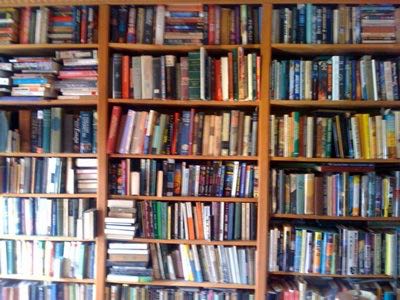
I like to just stand at a bookcase and look at the books. Apparently, Abell does too.
You can’t keep your e-books all in one place. 
Books arranged on your bookshelves don’t care what store they came from. But on tablets and smartphones, the shelves are divided by app — you can’t see all the e-books you own from various vendors, all in one place. There is simply no app for that. (With e-readers, you are doubly punished, because you can’t buy anything outside the company store anyway).
Apple doesn’t allow developers to tap into root information, which would be needed to create what would amount to a single library on an iOS device. If that restriction disappeared, there would still be the matter of individual vendors agreeing to cooperate — not a given since they are competitors and that kind of leveling could easily lead to price wars, for one thing. 
But the way we e-read is the reverse of how we read. To pick up our next physical book, we peruse bookshelves we’ve arranged and pick something out. In the digital equivalent, we would see everything we own, tap on a book and it would invoke the app it requires — Kindle, Nook, Borders, etc. With the current sequence — open up a reader app, pick a book — you can easily forget what you own. Trivial? Try to imagine Borders dictating the size and shape of your bookshelf, and enforcing a rule that it hold only books you bought from them, and see if that thought offends you even a little bit.
Good. I've been predicting the demise of print since I got in the publishing business about a thousand years ago, but I've long since given up expecting anything.

Wednesday, April 20, 2011

Are book shelf makers the new buggy whip makers?

The publishing tide is shifting fast: E-book sales in February topped all other formats, including paperbacks and hardcovers, according to an industry report released this week, CNNMoney reports.
E-book sales totaled $90.3 million in February, up 202% compared to the same month a year earlier, according to a study from the Association of American Publishers. That put e-books at No. 1 "among all categories of trade publishing" that month -- the first time e-books have beaten out traditional publishing formats.
Blame it on Santa Claus.
The AAP report attributed February's strong numbers to a post-holiday e-book buying surge by consumers who received e-readers devices as gifts.
Even bigger changes are coming, one industry insider says.
Earlier this month, Barnes & Noble executive Marc Parrish forecast that traditional book retailers have just two years to adapt to an e-book-centric industry. 
"The book business is changing more radically now, and quicker, than movies or music or newspapers have, because we're doing it in a matter of months," Parrish said at GigaOm's Structure Big Data conference in New York. "[The] next 24 months is when this business will totally shift."
What am I going to use to prop the door open?

Saturday, March 26, 2011

Toss those cookbooks

I've been going through the business throwing stuff away. Seems I've saved every telephone I've ever owned. There are three computer printers down there. And more books than the Library of Congress. What to keep?

An article in the New York Times has some advice, including this on books.
Keep them (with one exception). Yes, e-readers are amazing, and yes, they will probably become a more dominant reading platform over time, but consider this about a book: It has a terrific, high-resolution display. It is pretty durable; you could get it a little wet and all would not be lost. It has tremendous battery life. It is often inexpensive enough that, if you misplaced it, you would not be too upset. You can even borrow them free at sites called libraries. 
But there is one area where printed matter is going to give way to digital content: cookbooks. Martha Stewart Makes Cookies a $5 app for the iPad, is the wave of the future. Every recipe has a photo of the dish (something far too expensive for many printed cookbooks). 
Complicated procedures can be explained by an embedded video. When something needs to be timed, there’s a digital timer built right into the recipe. You can e-mail yourself the ingredients list to take to the grocery store. The app does what cookbooks cannot, providing a better version of everything that came before it.
Now all Martha has to do is make a decorative splashguard for a tablet and you will be all set.

Saturday, October 16, 2010

The surge in e-books

E-book sales for January to August are up from $89.8 million for 2009 to $263 million in 2010. This 193% increase in sales means that electronic books now account for almost 10% of consumer book sales in the U.S., up from just 3.31% in 2009.

Amazon already sells more Kindle books than hardcover texts, and in the overall market, sales of hardcover books were down 24.% in August when compared to last year (the AAP does not release monthly numbers for paperbacks). 

Wednesday, October 13, 2010

Changes afoot in textbook publishing

Customization and one-off printing are coming to textbooks, but right now the field is somewhat in chaos. The Chronicle of Higher Education reports:
McGraw-Hill Higher Education plans to announce its revamped custom-publishing system, called Create, with an emphasis on electronic versions of mix-and-match books. Macmillan Publishers this year announced a similar custom-textbook platform, called DynamicBooks. And upstart Flat World Knowledge touts the customization features of its textbooks, which it gives away online, charging only for printed copies and study guides. Other publishers have long offered custom-textbook services in print as well, though they have always represented just a sliver of sales.
Here's how it works:
The new Create system lets professors go to a Web site and select sections of 4,000 McGraw-Hill books, thousands of articles and case studies, or any document that the professors themselves upload. A price tag displays how much the resulting book will cost. Professors can then choose whether to make the book available to students as a printed book or an e-book. In a demonstration for The Chronicle this week, a book on health care cost about $6 as an e-book but jumped to $16.96 as printed book.
And there's a problem.
The system does not include material from other textbook publishers. That is typical of custom systems but makes it impossible for professors to blend a chapter from one publisher with a competitor's. When Macmillan announced its system, in February, it said it hoped that other publishers would join in its effort. But Mr. Stanford said McGraw-Hill had no intention of doing that, and he doesn't expect other publishers to want to join his company's project, either.

He said that as much as his company would love to become the iTunes store of e-textbooks, he didn't expect that to happen. "If any of us could be the distributor," he added, "we would."
I think it's just a matter of time. And I think that the first to recognize the ultimate customer -- the student -- will win. Right now college textbook publishing is a major revenue stream flowing from dwindling student resources.

Friday, August 27, 2010

How to write a book proposal

The slush pile
Gerard Van deur Leun, keeper of the American Digest blog, has been a book editor (200 titles), a magazine editor (1,000 + articles) and, briefly, a literary agent.

Here is his advice on book proposals:
Most failed to even engage my attention because they failed to tell me what I, as an editor, really needed to know.  Typically, writers get bogged down in creating a long, drawn out monster that was too turgid and too worked over to be of use.

A writer new to the game of publishing (and it is a game and a clumsy and ugly one) would always spend far too much time getting to yes or no. My writers would have a lot to say about their subjects and they seemed to feel that by saying a lot in the proposal they were improving their odds. Wrong. Less is more in this game, trust me.
And besides, a proposal is just that. A proposal. There's no sense in investing a huge amount of time in something that isn't going to be published and for which a writer is not going to be paid.
Here we go:

The 330 Word Book Proposal Schematic in 5 Parts

1) What the Book is About (1 -2 Pages)
Start with the title and subtitle. Make these two elements as attention grabbing as possible. They will be the "handle" the editor uses for pitching the book to the acquisition committee. Single-spaced, this section sets out the condensed form of the book. Think of it as expanded jacket copy. What's it about? What's its point of view. What is the arc and shape of the book? What patterns will it reveal? How will it educate, illuminate, amuse or inspire? Why is the book important now?

Function: This section gives the acquiring editor reasons for recommending the book for publication.

2) Chapter by Chapter Outline of the Book
Each chapter is given a title and then one or two paragraphs that set out what will be covered in the chapter when written.

Function: The allows the editor understand the structure of the book.

3) Sample Chapter
Pick one chapter from the outline and write it start to finish.

Function: This allows the editor to know how the author will write the book and, indeed, if the author can in fact write.

4) Core Market for the Book (1 Page)
Who is going to buy the book? Who are the people who will be interested in the book? Be fairly specific here. It's not a "There are 300 million people in the United States and they all eat, therefore my cook book...." argument. Editors want to have some idea of the "hard-core" market of buyers' the people who have to have it. Indicate other similar and/or complimentary books and influential magazine / web articles on the subject.

Function: Helps the editor identify and quantify the possible market for the book.

5) Why the Author is Qualified to Write This Book. (1 Page)
Why you? What are the author's particular qualifications for writing this book? Include degrees, writing experience, web credentials, background.

Function: Allows the editor to know that the author has the expertise to write the book.

Tuesday, June 8, 2010

Are books just for women?

Laura Miller, a senior writer at Salon.com, which she co-founded in 1995:
"One of publishing's truisms -- men don't read books -- has become self-fulfilling. Few men work in book publishing, so there are few supporters in the industry for books that men in particular might like, causing fewer such books to be published or promoted and finally leading men to think that books are not for them.

"It's worth asking, then, why there are so few men in publishing. Could it be the low pay, low status and ridiculous hours? (Remember that book editors seldom get to read manuscripts in the office -- that's what weekends are for.) Apart from a handful of celebrated figures, it's the rare editor who gets paid more than a secondary school teacher in a middle-class district. The profession has come to look a lot like a skilled, pink-collar ghetto, albeit garnished with a thin dusting of reflected glamor.

"Book editing, by contrast, increasingly resembles those "caring professions," nursing and teaching, where the joy of laboring selflessly on behalf of a noble cause -- in this case, literature -- is supposed to make up for the lack of profits and respect. And we all know who does that kind of job, don't we?"

Tuesday, May 25, 2010

A new chapter for books

Wade Roush at Technology Review:
For serious readers, products like Amazon's Kindle 2, Barnes and Noble's Nook, and Sony's Daily Edition are a godsend. It's not just that these electronic reading devices are handy portals to hundreds of thousands of trade books, textbooks, public-domain works, and best-sellers, all of which can be wirelessly downloaded at a moment's notice, and to scores of magazines and newspapers, which show up on subscribers' devices automatically.
They're also giving adventurous authors and publishers new ways to organize and market their creations. A California startup called Vook, for example, has begun to package cookbooks, workout manuals, and even novels with illustrative video clips, and it's selling these hybrids of video and text to iPhone, iPad, and iPod Touch owners through Apple's iTunes Store.

Unfortunately, you can't get away with charging hardcover prices for an e-book, which makes it hard to see how traditional publishers will profit in a future that's largely digital. As a result, book publishers are facing a painful and tumultuous time as they attempt to adapt to the emerging e-book technologies. The Kindle, the iPad, and their ilk will force upon print-centric publishers what the Internet, file sharing, and the iPod forced upon the CD-centric music conglomerates starting around 1999--namely, waves of cost cutting and a search for new business models.

Sunday, May 23, 2010

A new chapter in the book business

Is it hyperbole to say that the impact of the Internet is as profound, if not more so, than Gutenberg's?

From The Economist:
In 2009 Amazon sold 19% of printed books in North America, reckons Credit Suisse, compared with Barnes & Noble’s 17% and Borders’ 10%. By 2015, the bank estimates, Amazon will sell 28%.

Booksellers are labouring to raise their profile online and win back the customers they have lost. Barnes & Noble’s online sales rose by 32% to $210m in the quarter ending in January, compared with a year earlier. It has started selling its own e-reader, called the “Nook”, and digital books to go with it.

Will bookshops disappear completely, as music shops seem to be doing? Most are pinning their hopes on giving people more reasons to come inside. Many shops have started to offer free internet access to keep customers there longer and to enable them to download e-books.