Showing posts with label languages. Show all posts

Wednesday, February 23, 2011

Our difficulty with Arabic

"Just spell my name correctly!"
I have a theory that Americans find it hard to follow events in the Mideast and elsewhere, because we find it hard to follow their language. Just look at a list of terrorists -- can you pronounce their names? I often wonder how the CIA keeps track of them all.

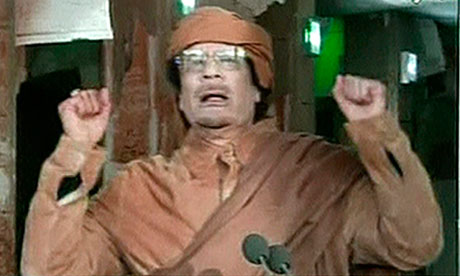
"Johnson," the excellent language blog at The Economist, takes a crack at explaining Arabic names, in particular that of Muammar Qaddafi.
NO ONE knows how much longer we'll have to write about Libya's dictator, so now seems a good time to take a crack at his name. Why is the man The Economist calls Muammar Qaddafi spelled so many different ways? A simple version of this question is sometimes phrased "Why can't we write it how they say it? There's got to be a best way." 
There are a few problems in turning Arabic into Roman letters. 
1) Arabic has sounds that aren't easily renderable in Roman letters without diacritics. The h-sound in "Tahrir" I mentioned the other day requires the International Phonetic Alphabet's ħ to distinguish it from English's h-sound, which Arabic also has. But of course most people aren't going to go to the length of finding and using special characters.

2) Arabic has moved a long way in the 14 centuries since the advent of Islam, but the writing system hasn't. Arabs still write with an alphabet suited to the sounds of classical Arabic, but which lacks many of the sounds used in modern dialects (and names).

3) When transliterating, experts like to try to match one Roman letter to each Arabic letter, so we don't have the Qaddafi problem, and so try to agree that q, for example, will always represent the Arabic letter called qaf, even though it sounds nothing like the English q. But, following on from 2 above, this usually means relying on the written form (which doesn't change) rather than the spoken (which can, from region to region or person to person).

If you were a linguist or other expert, with all of the tools of the trade to hand, you'd day something like "The name
القذافي
can carefully transliterated as al-Qaḏḏāfī, according to its Arabic spelling, but is pronounced by Libyans as al-Gaddāfī." 
This is because 
- In classical Arabic, the q beginning his name is pronounced like a k-sound made as far back in the throat as possible. But in many dialects including the main Libyan ones, it's pronounced like a g. So the q/g tradeoff is the one between how it's written and how it's said. K, meanwhile, isn't a great option here. It gets neither the Arabic spelling nor the pronunciation quite right. Kh is worse still. It is used to represent an Arabic sound—just not the one in Qaddafi's name. 
- the middle consonant isn't hard to say: in Classical Arabic it's just like the th sound in the English there. (Not like the one in third). But in modern Libyan Arabic, that sound has become a d-sound. So dh represents the spelling, d the pronunciation. Those who want to show that it's doubled in Arabic can opt for dd, as we do. 
If forced to pick, I'd say Qaddhafi represents the Arabic spelling pretty well, and Gaddafi represents the Libyan pronunciation pretty well. (The "al-" is optional. It's always used in Arabic but frequently left out in English. The Economist's style book recommends leaving it out in most names.) Our "Qaddafi" is a bit of a hybrid, but it's not the worst. Stay away from the k's and kh's, though, in any case. Those sounds do exist in Arabic, but not in the name Qaddafi.
You might want to share this with a spook you know.

Sunday, August 29, 2010

How language shapes our thinking

The language we speak does affect the way we think. This is because of what our language habitually obliges us to think about, Guy Deutscher, an honorary research fellow at the School of Languages, Linguistics and Cultures at the University of Manchester, writes.
Suppose I say to you in English that “I spent yesterday evening with a neighbor.” You may well wonder whether my companion was male or female, but I have the right to tell you politely that it’s none of your business. But if we were speaking French or German, I wouldn’t have the privilege to equivocate in this way, because I would be obliged by the grammar of language to choose between voisin or voisine; Nachbar or Nachbarin. These languages compel me to inform you about the sex of my companion whether or not I feel it is remotely your concern. This does not mean, of course, that English speakers are unable to understand the differences between evenings spent with male or female neighbors, but it does mean that they do not have to consider the sexes of neighbors, friends, teachers and a host of other persons each time they come up in a conversation, whereas speakers of some languages are obliged to do so.  
English imposes obligations as well.
English does oblige you to specify certain types of information that can be left to the context in other languages. If I want to tell you in English about a dinner with my neighbor, I may not have to mention the neighbor’s sex, but I do have to tell you something about the timing of the event: I have to decide whether we dined, have been dining, are dining, will be dining and so on. Chinese, on the other hand, does not oblige its speakers to specify the exact time of the action in this way, because the same verb form can be used for past, present or future actions. Again, this does not mean that the Chinese are unable to understand the concept of time. But it does mean they are not obliged to think about timing whenever they describe an action.
Even colors and the perception of art are affected.
Recently, it has been demonstrated in a series of ingenious experiments that we even perceive colors through the lens of our mother tongue. There are radical variations in the way languages carve up the spectrum of visible light; for example, green and blue are distinct colors in English but are considered shades of the same color in many languages. And it turns out that the colors that our language routinely obliges us to treat as distinct can refine our purely visual sensitivity to certain color differences in reality, so that our brains are trained to exaggerate the distance between shades of color if these have different names in our language. As strange as it may sound, our experience of a Chagall painting actually depends to some extent on whether our language has a word for blue.
Deutscher has put all this in a new book, from which this article is adapted: Through the Language Glass: Why the World Looks Different in Other Languages, to be published this month.

Thursday, May 20, 2010

Going Globish

Robert McCrum on the phenomenon of English in use everywhere, which he terms "Globish":

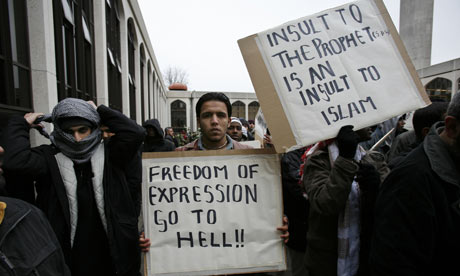
"In September 2005, Jyllands Posten (the Jutland Post), a culturally influential Danish newspaper, published a sequence of satirical cartoons poking fun at the prophet Muhammad, which provoked riots in which 139 people died. Possibly the most bizarre response to the affair, which surfaced again in January 2010 with an assault on the home of the artist, Kurt Westergaard, was a protest by Muslim fundamentalists outside the Danish embassy in London. Chanting in English, the protesters carried placards with slogans such as "Vikings Beware!", "Butcher Those Who Mock Islam", "Freedom of Expression Go to Hell" and (my favourite) "Down with Free Speech".

"This collision of the Koran with Monty Python, or perhaps of the OED with the Islamic Jihad, was the moment at which I began to reflect on the dramatic shift in global self-expression (I didn't have a word for it then) that was now asserting itself in this crisis, through a world united by the internet. What more surreal – and telling – commentary on the anglicisation of the modern world could there be than a demonstration by devout Muslims, in London, exploiting an old English freedom, and expressing it in the English language, to demand the curbing of the libertarian tradition that actually legitimised their protest?"

Tuesday, November 3, 2009

Wanna get ahead? Learn Mandarin

I had no idea that an estimated 7,000 languages are being spoken around the world. That number is expected to shrink rapidly in the coming decades.

Here are some factoids:
    •    6% of the world's languages are spoken by 94% of the world's population
    •    The remaining 94% of languages are spoken by only 6% of the population
    •    The largest single language by population is Mandarin (845 million speakers) followed by Spanish (329 million speakers) and English (328 million speakers).
    •    133 languages are spoken by fewer than 10 people


According to Ethnologue, a U.S. organization owned by Christian group SIL International that compiles a global database of languages, 473 languages are currently classified as endangered. Among the ranks are the two known speakers of Lipan Apache alive in the U.S., four speakers of Totoro in Colombia and the single Bikya speaker in Cameroon.