Showing posts with label words. Show all posts

Monday, June 23, 2014

Very important: how to not use "very"

"Substitute ‘damn’ every time you’re inclined to write ‘very;’ your editor will delete it and the writing will be just as it should be." ~ Mark Twain

It seems this word very once meant truthful. That was back in the 13th Century, when people didn't have anything better to do than use words correctly.

If you think of verily and verify, you get the original idea.

Somewhere along the line, it came to mean grievous or extreme. Somebody should be held to account for this switcheroo.

Is there is a life after very? Why, yes. We're just too lazy to discover it.

Amanda Patterson offers a helpful chart for those who wish to banish this most useless of words. Print this out and tape it to your computer.


We need no proof that good usage has practical value, but hear the words of author Nancy H. Kleinbaum: "So avoid using the word very because it’s lazy. A man is not very tired, he is exhausted. Don’t use very sad, use morose. Language was invented for one reason, boys -- to woo women -- and, in that endeavor, laziness will not do."

Monday, August 15, 2011

What's the opposite of opposite?

From National Review Online:

A reader writes:

Mr. Derbyshire,
In your July Diary on NRO you mentioned your annoyance with words that have no opposite. Earlier today I was discussing languages with a friend and I recalled that in the past I have used the word “shallow” as a sort of vague, inexact opposite to “steep”, but it never seemed right. What is the actual opposite of “steep”? What word can you put in place of “steep” in “this mountain is very steep” to make it mean the opposite? I don’t think there is one.
Just so. We need an adjective to describe words like this — words with no opposite. “Anantonymous”?

But then … what would be the opposite?

Monday, October 11, 2010

Horrible words

The Economists' language blog, Johnson, takes a post from the magazine's style guide on horrible words.
Words that are horrible to one writer may not be horrible to another, but if you are a writer for whom no words are horrible, you would do well to take up some other activity. No words or phrases should be banned outright from appearing in print, but if you use any of the following you should be aware that they may have an emetic effect on some of your readers:
carer and most caring expressions
chattering classes
facilitate
famously
Governance
grow the business
guesstimate
informed (as in his love of language informed his memos)
leverage
likely (meaning probably, rather than probable)
looking to
materiel
poster child
prestigious
proactive
rack up (profits etc)
savvy
segue
source (meaning obtain)
stakeholder


Facilitate, proactive and leverage are at the top of my list.

Tuesday, July 6, 2010

Weasel words to avoid at work

"Try"
"Try" is a weasel word. "Well, I'll try," some people say. It's a cop-out. They're just giving you lip service, when they probably have no real intention of doing what you ask. Remember what Yoda says to Luke Skywalker in "Star Wars": "Do or do not--there is no try."

"Whatever"
This word is a trusted favorite of people who want to dismiss you, diminish what you say, or get rid of you quickly. "Whatever," they will say as an all-purpose response to your earnest request. It's an insult and a verbal slap in the face. It's a way to respond to a person without actually responding. When you say "whatever" after another person has said his or her piece, you have essentially put up a wall between the two of you and halted any progress in communicating.

"I'll get back to you"
When people need to buy time or avoid revealing a project's status, they will say, "I'll get back to you," and they usually never do. If people say they will get back to you, always clarify. Ask them when they will get back to you, and make sure they specify the day and time. If they don't, then pin them down to a day and time and hold them to it. If they won't give you a day or time, tell them you'll call in a day or week and follow up. Make sure you call and get the information you need.

"Yes, but . . ."
This is another excuse. You might give your team members suggestions or solutions, and they come back to you with "Yes, but . . ." as a response. They don't really want answers, help, or solutions. You need to call the "Yes, but . . ." people out on their avoidance tactic by saying something like "You know, Jackie, every time I offer you a suggestion you say, 'Yes, but . . . ,' which makes me think you don't really want to solve this problem. That's not going to work. If you want to play the victim, go right ahead, but I'm not going to allow you to keep this up." After a response like that, you can be assured that the next words you hear will not be "Yes, but . . ."!

Friday, March 19, 2010

If you can't say something nice

From Maggie's Farm:

"Euphemisms are about creating an illusion of a nursery school pretty pony and rainbow view of the world in which evil does not exist, in which we can all get along if only we wanted to, and in which we can all be anything we want, if only we would label things properly.

"Rabid Jihadists and criminals become "the oppressed," kids who cannot read well become "learning disabled," klutzes become "hand-eye coordination impaired," the socially-awkward become "Asperger's," global warming becomes "climate change," housing developments in swamps become "Riverview Estates" - and Killer Whales become cuddly "Orcas" (so as not to offend their delicate sensibilities, no doubt)."

Monday, March 8, 2010

This is inappropriate

Edward Skidelsky is a lecturer in philosophy at Exeter University. His book Ernst Cassirer: The Last Philosopher of Culture is published by Princeton University Press.
"No words are more typical of our moral culture than “inappropriate” and “unacceptable.” They seem bland, gentle even, yet they carry the full force of official power. When you hear them, you feel that you are being tied up with little pieces of soft string.

"Inappropriate and unacceptable began their modern careers in the 1980s as part of the jargon of political correctness. They have more or less replaced a number of older, more exact terms: coarse, tactless, vulgar, lewd. They encompass most of what would formerly have been called “improper” or “indecent.” An affair between a teacher and a pupil that was once improper is now inappropriate; a once indecent joke is now unacceptable.

"This linguistic shift is revealing. Improper and indecent express moral judgements, whereas inappropriate and unacceptable suggest breaches of some purely social or professional convention. Such “non-judgemental” forms of speech are tailored to a society wary of explicit moral language. As liberal pluralists, we seek only adherence to rules of the game, not agreement on fundamentals. What was once an offence against decency must be recast as something akin to a faux pas."

Saturday, February 13, 2010

Grammar police: it's important

its and it’s
 
The secret here is that pronouns don’t take “apostrophe plus S” to make them possessive. Decide whether you can change the “apostrophe plus S” to “is.” (Example – It’s going to be a long time before the tech comes, so the copy machine is going to keep spitting out its paper regularly.) Since you could say “It is going to be a long time...” you know the apostrophe form is correct. But you wouldn’t want to say “...spitting out it is paper regularly.” Pronouns don’t take “apostrophe plus S” to form the possessive: That is [my, your, her, his, its, their, our] book. Even when shifting a sentence to a little different form, NONE of them use the apostrophe: The book is [mine, yours, hers, his, its, theirs, ours].

Tuesday, February 9, 2010

Do you do the probity thing?

probity / pro-bê-tee / noun
Total honesty, integrity and virtue, uprightness, high moral character.
Dr. Goodword opines:

Probity pretty much stands alone as a lexical orphan though it has distant cousins in prove and its family. Probity has a meaning similar to honesty and uprightness but in a more pristine sense. Honesty and uprightness may be more or less but probity is both these in their purest form.

Another way of defining probity would be to say that it means "no messing around": "Sarah Soda's drabness and the advanced years of Jerry Attrick guaranteed the probity of their late night dinners together." It is not always easy to distinguish probity from the appearance of probity: "Looking for a needle in a haystack is like looking for probity on Wall Street."

History: English borrowed probity, like so many other words from French. French (Latin as spoken in France today) inherited the word from Latin probitas "uprightness, honesty", a noun based on the adjective probus "worthy, good". Probus went into the making of probare "to prove worthy, to test". This verb ended up in Old French as prover, which English also borrowed as prove. While raising its debt level to Latin and the Romance languages, English also borrowed probare directly from Latin as probe. Where did probus itself come from? It goes back to a pre-Latin Proto-Indo-European derived word pro-bhwo- "being up front", made up of pro "in front of" + bhwo- "to be", the source of English be.

Monday, February 8, 2010

This blog is filled with apercus

apercu / ah-per-su/ noun
1. A perceptive insight.
2. A brief summary.
Dr. Goodword asks:

What should we do with the French beard on the C (aperçu) in the English spelling of this word? This is a question, I'm sure, you have struggled with for a long time. The major dictionaries leave it on, but my spellchecker shaves it off. If you have difficulty finding it on your keyboard, just ignore it. On the other hand, the French spelling does make the word a bit cuter. The plural of today's word is, as we might expect, apercus (or aperçus).

How to use it:

Apercu, the good doctor informs, works when you tire of using summary or the French word with the cap on the E, précis: "Farley, the entire history of your life is unnecessary; a simple apercu will suffice." The other sense gives your speech or writing a little lift when you wish to express the sense of an insight: "Frank's report was comprehensive but lacked any pithy apercu into how we can solve the problem."

History: Apercu is the past participle of the French verb apercevoir "to perceive", freshly borrowed by English, beard and all. No attempt has been made to hide its point of origin. The French verb comes from Latin ad "(up) to" + percipere "to grasp, take possession of", comprising per- "through, thorough" + capere "to grasp, seize". The same root *kap-, became haben "have" in German and guess what in English. We see the effects of capere in capture, capacious, intercept, and many other English words snipped from the Latin lexicon.

Friday, February 5, 2010

The most looked-up words in 2009

The 2009 Merriam-Webster's Words of the Year list is based on actual user lookups to the Merriam-Webster Online Dictionary and Online Thesaurus.

The word of the year that received the highest intensity of searches over the shortest period of time is admonish.

"Admonish shot to the top of the list three days after Rep. Joe Wilson's outburst during a speech made by President Obama, and it remained among our top lookups for weeks," said Peter A. Sokolowski, Merriam-Webster's Editor at Large. "When the House announced plans to 'admonish' Rep. Wilson, the word was understood to be technical or official, and it has been repeated often in coverage of recent contentious political issues. While this particular story wasn't very important in the context of a year's worth of news, it triggered enormous interest in this word."

admonish (verb)
: to express warning or disapproval to especially in a gentle, earnest, or solicitous manner

The other words:
  1. emaciated
  2. empathy
  3. furlough
  4. inaugurate
  5. nugatory
  6. pandemic
  7. philanderer
  8. repose
  9. rogue
Traffic to Merriam-Webster.com now exceeds 1.3 billion individual page views per year. On average, there are approximately ten lookup requests in the Merriam-Webster Online Dictionary or Thesaurus per second. During peak hours, this may increase to more than 100 requests per second.

Wednesday, February 3, 2010

This avatar thing

There's a movie named "Avatar," which I have no intention of seeing but which prompted Dr. Goodword to look into the word.

avatar / æ-vê-tah(r)/ noun
1. The incarnation of a Hindu deity in human form.
2. An epitome, archetype, or embodiment of something, as the avatar of good or evil.
3. (Computers, Web) A character or image assumed by a player in a computer or online game.
Avatars are abstract ideas in real (human) form, the good doctor explains: "Barney Smith was an avatar of the modern investment broker until his investment in derivatives destroyed his company in the 2008 banking crash." The source of our principles can usually be portrayed as avatars: "I would not have survived to adulthood had my mother not been an avatar of kindness and the unflickering cynosure of my teen years." In the movie, the name wanders a bit off course, since the good guys are really clones of themselves rather than incarnations of abstract ideals.

History: Avatar comes from Sanskrit avatarah "descent" and the sense of this word has descended from the incarnation of a god to an image manipulated by someone in a computer game. The Sanskrit word comprises ava "down" + tarati "crosses over". The root of tarati also appears in tiram "brink" in Sanskrit (the oldest known Indo-European language), a sense that the Greek cast into its variation of the same word, terma "goal". Latin kept the sense of the original word in trans "across, over" but still used the newer sense in terminus "boundary, limit".

Image: Vishnu in the centre of his ten avatars. Hindus believe that sometimes a god will appear on the earth as a person or an animal. These are called avatars. The most important of the avatars are those of Vishnu who has appeared nine times, each time to save the earth.

This blog hasn't tipped the tuna

A couple of  terms for you trendy types.

Tipped the tuna
Started peaking in popularity.
Oddly, this phrase itself tipped the tuna when used in reference to the socal networking service Twitter. A commonly cited source is this blog post by Ross Mayfield "On Wednesday, Twitter tipped the tuna."

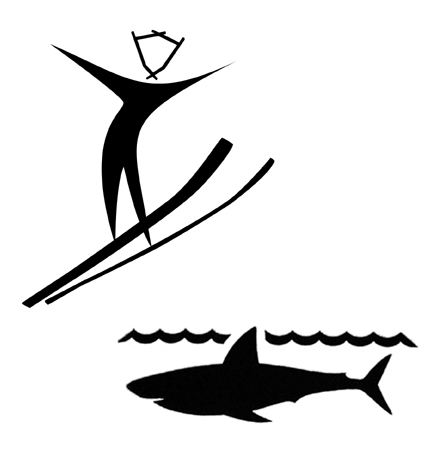
Jump the shark
A term to describe a moment when something that was once great has reached a point where it will now decline in quality and popularity.
Origin of this phrase comes from a Happy Days episode where the Fonz jumped a shark on water skis. Thus was labeled the lowest point of the show.

Tuesday, January 12, 2010

Are you inferring that I'm implying?

Listen and you'll hear people misuse these words. You don't, of course.

infer and imply

The difference between these two involves whether there is some assuming going on by the reader or listener. “Imply” means that something is inherent in the text or conversation without being explicitly stated. (Example – When the teacher stated that the test results were not good, she implied that few, if any, students got good grades.)

On the other hand, “infer” is when the reader or listener draws some kind of conclusion. (Example – When the teacher told us that we would all have to retake the test, we inferred this was because few, if any, of us got a good grade on it.)

Monday, January 11, 2010

Incoming!

Here's an interesting word we all use in one way or another.

flak / flæk / noun
1. Antiaircraft fire, rounds from antiaircraft artillery.
2. Heavy abusive criticism.
Dr. Goodword points to the definition I know as a journalist, using a different spelling:

Be careful to avoid inserting a C in this word. Some folks think that since it rhymes with black, it should look like black, right? Not really. As the Word History will show, the rhyme of this word is purely coincidental and, even though US dictionaries condone the folk-etymological spelling, this word should be spelled without a C. A flack is a booking agent or publicity man (since 1946) and a bulletproof vest is a flak-jacket, with only one C.

Flak, Dr. Goodword tells us, started out referring to fire aimed at bombers by antiaircraft artillery on the ground. Today, however, this word generally refers to harsh criticism: "Henry took so much flak for suggesting his company produce helicopter ejection seats that he decided to duck staff meetings in the future."

History: Flak first appeared in the 1938 edition of Jane's Fighting Ships. It was borrowed directly from German, where it was an abbreviation for Fliegerabwehrkanone "pilot defense cannon". The German word Flieger "pilot, flyer" comes from the verb fliegen, which shares an origin with English fly. The original root was plau-, which emerged in Lithuanian as plaukti and Russian plavat', both meaning "swim, float, sail". The same original root became plunein "to wash, bathe" in Greek and ended up in English as flow as well as fly.

When writing or speaking, decline to divagate

divagate / di-vê-gayt / verb, intransitive (no object)

1. To wander about, meander, drift about in different directions.
2. To ramble, digress, stray from the point in speaking, writing, or thinking.

Divagate hasn't been used much since the 19th century, but that is no reason to avoid applying it today. There is still plenty of divagation (the action noun) in the world and divagators (the personal noun) who need to know what it is called.

Anything that moves in no particular direction divagates: "After puncturing the balloon with a pin, little Abner watched it rapidly divagate around the room before plopping to the floor." Abstractions divagate as well as concrete objects: "About halfway through his lecture on raising rice in South Carolina, Llewellyn divagated into a suite of reveries about partying his summers away in his ocean-front house at Myrtle Beach."

Divagate, of course, comes from Latin, this time from the past participle, divagatus, of divagare "to wander around", made up of di(s)- "away, apart from" + vagari "to wander". The root vagari was derived from vagus "strolling, wandering", a word which also ended up in English as vague, borrowed from Latin's descendant language, French. Although it resembles divagate a bit, navigate comes from a completely different source. It is built of navis "ship" + agere "to drive, lead", the root of English borrowings agent and act.

Wednesday, December 30, 2009

Top phrases of the decade

I wrote recently of the "top words" of the decade, based on calculations of The Global Language Monitor, which uses a math formula to track the frequency of words and phrases in print and electronic media.

Here are the top phrases of the decade.

1. Climate Change (2000) Green words in every form   dominant the decade
2. Financial Tsunami (2008) One quarter of the world’s wealth vanishes seemingly overnight
3. Ground Zero (2001) Site of 9/11terrorist attack in New York City
4. War on Terror (2001)  Bush administration’s response to 9/11
5. Weapons of Mass Destruction (2003)  Bush’s WMDs never found in Iraq or the Syrian desert
6. Swine Flu (2008) H1N1, please, so as not to offend the pork industry or religious sensitivities!
7. “Let’s Roll!” (2001)  Todd Beamer’s last words before Flight 93 crashed into the PA countryside
8. Red State/Blue State (2004) Republican or Democratic control of states
9. Carbon footprint (2007) How much CO² does an activity produce?
10. Shock-and-awe (2003) Initial strategy of Iraq War
11. Ponzi Scheme (2009) Madoff’s strategy reaped billions & heartache
12. Category Four (2005) Force of Hurricane Katrina hitting New Orleans’ seawalls and levies
13. King of Pop (2000)  Elvis was the King, MJ the King (of Pop)
14. “Stay the Course” (2004) Dubya’s off-stated guidance for Iraq War
15. “Yes, we can!” (2008)   Obama’s winning campaign slogan
16. “Jai Ho!” (2008)  Shout of joy from ‘Slumdog Millionaire’
17. “Out of the Mainstream” (2003) Complaint about any opposition’s political platform
18. Cloud computing (2007)  Using the Internet as a large computational device
19. Threat Fatigue (2004)   One too many terrorist threat alerts
20. Same-sex marriage (2003) Marriage of gay couple

Saturday, December 26, 2009

The top words of the decade

The Global Language Monitor, which uses a math formula to track the frequency of words and phrases in print and electronic media, has announced the top Words of the decade, as part of its annual global survey of the English language.

The top words were ‘global warming’, 9/11, and Obama, followed by bailout, evacuee, and derivative; Google, surge, chinglish, and tsunami followed. “Climate change” was the top phrase, while “Heroes” was the top name; bin-Laden was No. 2.


The words are culled from throughout the English-speaking world, which now numbers more than 1.58 billion speakers.
 

“Looking at the first decade of the 21st century in words is a sober, even somber, event.” said Paul JJ Payack, President of The Global Language Monitor. “For a decade that began with such joy and hope, the words chosen depict a far more complicated and in many ways, tragic time. Nevertheless, signs of hope and renewal can be found in the overall lists.”

Tuesday, December 22, 2009

Look before you leap

"The difference between the right word and the almost right word 
is really a large matter — it's the difference 
between a lightning bug and the lightning." -- Mark Twain

A few days ago President Obama opined: " ... it's clear that we are on the precipice of an achievement that's eluded Congresses and presidents for generations, a achievement that will touch the lives of nearly every American."

His use of the word precipice has been much noted, and the point most often made is that it is a particularly poor choice of words when referring to the health care bill, given that precipice carries the suggestion of danger, and for many people national health care would be dangerous.

From dictionary.com we get these definitions:
1. a cliff with a vertical, nearly vertical, or overhanging face.
2. a situation of great peril: on the precipice of war.
The word's history only makes it worse: 1598, "fall to great depth," from Fr. précipice, from L. præcipitium "a steep place," lit. "a fall or leap," from præceps (gen. præcipitis) "steep, headlong, headfirst," from præ- "forth" + caput "head".

Look before you leap, and think before you speak.

Friday, December 18, 2009

Don't you hate to hear this?

If you're in business it pays to pay attention to the words you use with your customers.

Writing in The New York Times, Stanley Fish notes:

There is a class of utterances that, when encountered, produces irritation, distress and, in some cases, the desire to kill. You hear or read one of these and your heart sinks. Everyone will have his or her (non)favorites. Mine is a three-word announcement on the TV screen, “To Be Continued,” which says, “I know that you have become invested in this story and are eager to find out how it ends, but you’re going to have to wait for a few days or a week or a month or forever.”

Here are others. What others do you hate?
  • Sold out.
  • Closed for Private Party
  • Back in an Hour
  • Not in Service
  • Use Other Door
  • Register Closed
  • This may hurt a little
  • Your call is important to us
  • I’m sorry, but I don’t recognize your response
  • May I put you on hold for a minute?
  • Your card has been denied
  • To return to the menu
  • Please listen carefully as our menu options have changed
  • Invalid user name
  • Assembly Required