Showing posts with label rules for writing. Show all posts

Tuesday, July 15, 2014

The CIA's rules for writing

Yup, it has them. A freedom of information request brought them in out of the cold. Here's what the spymasters think their underlings should know.

All writers using the guide, it says, "are assumed already to possess the three essentials of intelligence analysis: knowledge, clarity of thought, and good judgment. No writing, however skilled, can conceal deficiencies in these requisites.”

See if these rules are helpful for you:
  • Keep the language crisp and pungent; prefer the forthright to the pompous and ornate.
  • Do not stray from the subject; omit the extraneous, no matter how brilliant it may seem or even be.
  • Favor the active voice and shun streams of polysyllables and prepositional phrases.
  • Be frugal in the use of adjectives and adverbs; let nouns and verbs show their own power.
  • Be objective; write as a reporter or analyst or administrator unless you are entitled to write as a policymaker.
This is a commandment for any business writer.
For the most part, Directorate of Intelligence analysts are writing for generalists. Generalists may have deep expertise in specific areas, such as missile technology or a country’s tribal politics; nonetheless, the analyst’s goal is to do away with the specialist’s jargon and to put everything into layman’s language. If your audience consists of just a few people who thoroughly understand the subject (or who cannot be trusted to follow the reasoning without jargon to guide them), by all means sprinkle your piece with technical terms. Most of the time, however, write for the nonexpert.
I'm glad this secret leaked.

Monday, July 7, 2014

Zadie Smith's rules for writing

Zadie Smith is a British novelist, essayist and short story writer. She has published four novels, all of which have received substantial critical praise. In 2003, she was included on Granta's list of 20 best young authors, and was also included in the 2013 list. She joined New York University's Creative Writing Program as a tenured professor on September 1, 2010.
Here are her rules for writing:
  1. When still a child, make sure you read a lot of books. Spend more time doing this than anything else.
  2. When an adult, try to read your own work as a stranger would read it, or even better, as an enemy would.
  3. Don’t romanticise your ‘vocation’. You can either write good sentences or you can’t. There is no ‘writer’s lifestyle’. All that matters is what you leave on the page.
  4. Avoid your weaknesses. But do this without telling yourself that the things you can’t do aren’t worth doing. Don’t mask self-doubt with contempt.
  5. Leave a decent space of time between writing something and editing it.
  6. Avoid cliques, gangs, groups. The presence of a crowd won’t make your writing any better than it is.
  7. Work on a computer that is disconnected from the ­internet.
  8. Protect the time and space in which you write. Keep everybody away from it, even the people who are most important to you.
  9. Don’t confuse honours with achievement.
  10. Tell the truth through whichever veil comes to hand — but tell it. Resign yourself to the lifelong sadness that comes from never ­being satisfied.
I particularly like the practicality of 1, 2, and 5. These are sturdy rules you learn either from experience or from an accomplished writer like Smith.

Wednesday, October 10, 2012

A formula for success

Michael Frayn, one of Britain's best-loved authors:

"Let me say for a start that I don’t think it is a very good idea to write different sorts of things. If I were to give serious practical advice to a young writer about how to succeed I would say, Write the same book, or the same play, over and over again, just very slightly different, so that people get used to it. It takes some time, but if you do it often enough, finally people will get the hang of it, and get familiar with it, and they’ll like it. 

"Then you go on producing a consistent product and you’ll have a market for it. Because the consumer of books or plays, including myself, very reasonably wants to know or have some idea in advance what the book or the play is going to be like. It is the same as buying breakfast cereal: if you buy a packet of cornflakes, you want to be sure it will contain cornflakes and not muesli. It is very irritating if the packet doesn’t contain what you expected it to contain. Similarly it is a reasonable demand from the theatergoer or novel reader that he should get a constant product, which is identified by the author’s brand name.

"If I could have done this, I would have. But I don’t have much control over what I produce. All I can do is to write the stories that come to me. And what a story is, is in part the way of telling it. A story is not an event in the outside world—it consists in the telling. It is only when you think that you have found a way of telling the story that you can start writing it. Different stories naturally suggest different ways of telling them. If I had been better organized as a writer, I would have gone beyond the stories’ dictates and imposed my own central imprint on everything.

Thursday, September 20, 2012

Elmore Leonard's10 rules of writing


1. Never open a book with weather. If it's only to create atmosphere, and not a charac­ter's reaction to the weather, you don't want to go on too long. The reader is apt to leaf ahead look­ing for people. There are exceptions. If you happen to be Barry Lopez, who has more ways than an Eskimo to describe ice and snow in his book Arctic Dreams, you can do all the weather reporting you want.

2. Avoid prologues: they can be ­annoying, especially a prologue ­following an introduction that comes after a foreword. But these are ordinarily found in non-fiction. A prologue in a novel is backstory, and you can drop it in anywhere you want. There is a prologue in John Steinbeck's Sweet Thursday, but it's OK because a character in the book makes the point of what my rules are all about. He says: "I like a lot of talk in a book and I don't like to have nobody tell me what the guy that's talking looks like. I want to figure out what he looks like from the way he talks."

3. Never use a verb other than "said" to carry dialogue. The line of dialogue belongs to the character; the verb is the writer sticking his nose in. But "said" is far less intrusive than "grumbled", "gasped", "cautioned", "lied". I once noticed Mary McCarthy ending a line of dialogue with "she asseverated" and had to stop reading and go to the dictionary.

4. Never use an adverb to modify the verb "said" ... he admonished gravely. To use an adverb this way (or almost any way) is a mortal sin. The writer is now exposing himself in earnest, using a word that distracts and can interrupt the rhythm of the exchange. I have a character in one of my books tell how she used to write historical romances "full of rape and adverbs".

5. Keep your exclamation points ­under control. You are allowed no more than two or three per 100,000 words of prose. If you have the knack of playing with exclaimers the way Tom Wolfe does, you can throw them in by the handful.

6. Never use the words "suddenly" or "all hell broke loose". This rule doesn't require an explanation. I have noticed that writers who use "suddenly" tend to exercise less control in the application of exclamation points.

7. Use regional dialect, patois, sparingly. Once you start spelling words in dialogue phonetically and loading the page with apos­trophes, you won't be able to stop. Notice the way Annie Proulx captures the flavour of Wyoming voices in her book of short stories Close Range.

8. Avoid detailed descriptions of characters, which Steinbeck covered. In Ernest Hemingway's "Hills Like White Elephants", what do the "Ameri­can and the girl with him" look like? "She had taken off her hat and put it on the table." That's the only reference to a physical description in the story.

9. Don't go into great detail describing places and things, unless you'reMargaret Atwood and can paint scenes with language. You don't want descriptions that bring the action, the flow of the story, to a standstill.

10. Try to leave out the part that readers tend to skip. Think of what you skip reading a novel: thick paragraphs of prose you can see have too many words in them.

My most important rule is one that sums up the 10: if it sounds like writing, I rewrite it.

Wednesday, September 19, 2012

George Orwell's rules for writing


  1. Never use a metaphor, simile, or other figure of speech which you are used to seeing in print.
  2. Never use a long word where a short one will do.
  3. If it is possible to cut a word out, always cut it out.
  4. Never use the passive where you can use the active.
  5. Never use a foreign phrase, a scientific word, or a jargon word if you can think of an everyday English equivalent.
  6. Break any of these rules sooner than say anything outright barbarous.

Monday, September 10, 2012

Some tips on the craft

Mary Jaksch, Chief Editor of Write to Done, offers these.

Use simple, declarative sentences.
Avoid passive voice.
Limit your use of adjectives and adverbs.
Keep it simple.
Cut the crap.
Don’t overwrite.
Go easy on descriptive narrative (settings, people, etc.).
Re-examine every word that’s three syllables or longer and see whether it could be replaced by a simpler word.
If you have a sense of where you want your piece to wind up, start there instead and see what happens.
Avoid these three weak words – unless absolutely necessary: Ifs, Buts, and Can’ts.
Never rescue your hero.
Practice monotasking. Set a timer for uninterrupted writing.
Work on brilliant headlines.
Start with metaphors and stories.
Write the opening sentence or headline last.
Write solely from the heart and shun copying others.
Think before you include an expletive.
Ask, “Can it be turned into a list?” Think of at least five things you can list about it.
Use the mini-skirt rule: Make it long enough to cover everything, but short enough to keep it interesting.
Write in small paragraphs in order to get to the point immediately.
Visualize the person you are communicating with: What do their eyes reflect as they read this? What will the first thing they might say in response?
Do what works for you.
Always call a spade a spade. It’s never a long-handled gardening implement!
Try writing without accuracy. Not worrying about errors (left brain) allows for easier flow of thought (right brain).

Sunday, January 1, 2012

Simple rules for writing well

The Economist Style Guide, largely the work of editor John Grimond, is helpful, sensible, and refreshingly unstuffy, blogger Richard Nordquist writes. In other words, it heeds its own advice.

That good advice first shows up in the introduction, which offers eight precepts for keeping our readers engaged.
Catch the attention of the reader.Then get straight into the article. Do not spend several sentences clearing your throat, setting the scene or sketching in the background. 
Read through your writing several times.
Edit it ruthlessly, whether by cutting or polishing or sharpening, on each occasion. . . . Nothing is to be gained by resorting to orotundities and grandiloquence, still less by calling on clichés and vogue expressions. Unadorned, unfancy prose is usually all you need. 
Do not be stuffy.
Use the language of everyday speech, not that of spokesmen, lawyers or bureaucrats. . . . Pomposity and long-windedness tend to obscure meaning, or reveal the lack of it: strip them away in favour of plain words. 
Do not be hectoring or arrogant.
Those who disagree with you are not necessarily stupid or insane. Nobody needs to be described as silly: let your analysis show that he is. 
Do not be too pleased with yourself.
Don’t boast of your own cleverness by telling readers that you correctly predicted something or that you have a scoop. You are more likely to bore or irritate them than to impress them. 
Do not be too chatty.
Surprise, surprise is more irritating than informative. So is Ho, ho and, in the middle of a sentence, wait for it, etc. 
Do not be too didactic.
If too many sentences begin Compare, Consider, Expect, Imagine, Look at, Note, Prepare for, Remember or Take, readers will think they are reading a textbook (or, indeed, a style book). 
Do your best to be lucid.
(“I see but one rule: to be clear,” Stendhal) Simple sentences help. Keep complicated constructions and gimmicks to a minimum. . . . Clear thinking is the key to clear writing.

Tuesday, September 14, 2010

Cut the clutter

Richard Nordquist on his Grammar & Composition blog:

1. Reduce Long Clauses. When editing, try to reduce long clauses to shorter phrases:
Wordy: The clown who was in the center ring was riding a tricycle.
Revised: The clown in the center ring was riding a tricycle
2. Reduce Phrases. Likewise, try to reduce phrases to single words:
Wordy: The clown at the end of the line tried to sweep up the spotlight.
Revised: The last clown tried to sweep up the spotlight.
3. Avoid Empty Openers. Avoid There is, There are, and There were as sentence openers when There adds nothing to the meaning of a sentence:
Wordy: There is a prize in every box of Quacko cereal.
Revised: A prize is in every box of Quacko cereal.
Wordy: There are two security guards at the gate.
Revised: Two security guards stand at the gate.
4. Don't Overwork Modifiers. Do not overwork very, really, totally, and other modifiers that add little or nothing to the meaning of a sentence.
Wordy: By the time she got home, Merdine was very tired.
Revised: By the time she got home, Merdine was exhausted
Wordy: She was also really hungry.
Revised: She was also hungry [or famished].
5. Avoid Redundancies. Replace redundant expressions (phrases that use more words than necessary to make a point) with precise words.
Wordy: At this point in time, we should edit our work.
Revised: Now we should edit our work.

Monday, June 28, 2010

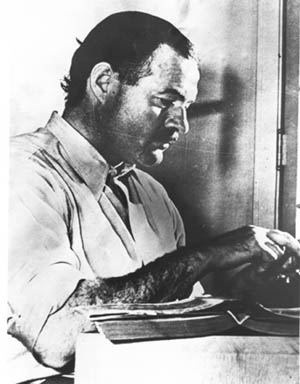
How Hemingway learned to write like Hemingway

Ernest Hemingway wrote for the Kansas City Star from October 1917 to April 1918, and there he learned the elements of his style.

As Star columnist Jim Fisher has written, Hemingway's style grew from:
``The Star Copy Style'' sheet, a single, galley-sized page, which contained 110 rules governing Star prose. Hemingway later would recall the sheet as something ``they gave you to study when you went to work and after that you were just as responsible for having learned it as after you've had the articles of war read to you.''

Hemingway would always remember the style sheet and its core admonition: ``Use short sentences. Use short first paragraphs. Use vigorous English. Be positive, not negative.''

``Those were the best rules I ever learned for the business of writing,'' Hemingway said in 1940. ``I've never forgotten them. No man with any talent, who feels and writes truly about the thing he is trying to say, can fail to write well if he abides with them.''

The ``Copy Style'' sheet was a bible, containing eminently practical rules. Some others:
  • Never use old slang. Such words as stunt, cut out, got his goat, come across, sit up and take notice, put one over, have no use after their use has become common. Slang to be enjoyable must be fresh.
  • Eliminate every superfluous word as Funeral services will be at 2 o'clock Tuesday, not The funeral services will be held at the hour of 2 o'clock Tuesday. Avoid the use of adjectives, especially such extravagant ones as splendid, gorgeous, grand, magnificent, etc.
  • Don't say, He had his leg cut off in an accident. He wouldn't have had it done for anything.
  • He was eager to go, not anxious to go. You are anxious about a friend who is ill.
  • He died of heart disease, not heart failure -- everybody dies of heart failure.''